

It’s a sound that can drive you crazy—that relentless hum of the furnace fan, running long after the heat has kicked off. If you've noticed your furnace blower won't quit, especially here in the St. Cloud or Sauk Rapids area, don't panic just yet. Before you start imagining worst-case scenarios and expensive repair bills, the answer is often right on your wall.
The number one reason a furnace fan runs nonstop is a simple thermostat setting.
Understanding Why Your Furnace Fan Runs Constantly
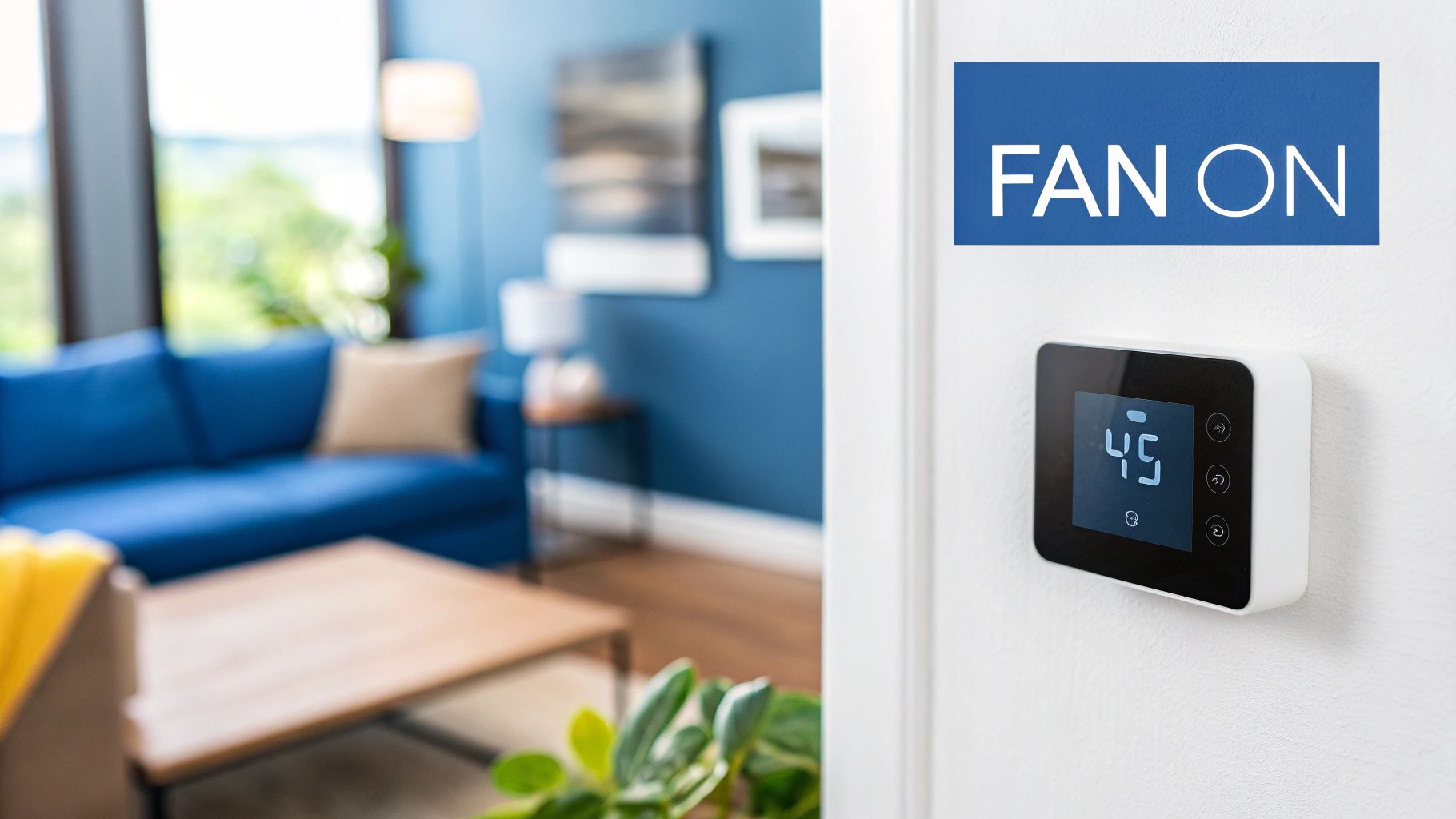
More often than not, the culprit is a little switch on your thermostat that's been flipped from ‘AUTO’ to ‘ON’. It's an easy mistake to make, but it completely changes how your system operates. Let's break down what those two settings actually do.
The Difference Between ON and AUTO
The distinction between 'ON' and 'AUTO' is simple but critical.
When your thermostat's fan is set to 'AUTO', the blower only kicks on when your furnace is actively heating (or your AC is cooling). It pushes the conditioned air through your home and then shuts off when the temperature is right. This is the setting you'll want to use most of the time for energy efficiency.
On the other hand, the 'ON' setting is exactly what it sounds like. It tells the blower fan to run 24/7, no matter what the furnace is doing. This isn't a sign of a broken furnace; it's a feature designed for continuous air circulation.
Is It Good to Run the Fan Constantly?
So, is it bad to leave the fan running all the time? Not necessarily. Intentionally setting it to 'ON' actually has a few benefits, but it also comes with some trade-offs.
- Better Air Circulation: A constantly running fan helps even out the temperature in your home, getting rid of those annoying hot and cold spots between rooms or floors.
- Improved Air Filtration: Because air is always moving through your furnace filter, it can trap more dust, pet dander, and other allergens, which is great for indoor air quality.
- Year-Round Comfort: During those mild spring or fall days, it creates a gentle breeze that keeps the air from feeling stale or stuffy without needing to run the heat or AC.
Key Takeaway: While constant fan operation improves comfort and air quality, it comes at a cost. You'll see a bump in your electricity bill, and it puts more wear and tear on the blower motor. You'll also need to change your furnace filter much more often to keep things running efficiently.
If you've checked your thermostat and the fan is definitely set to 'AUTO' but it's still running nonstop, then we've got a different problem on our hands. It's time to dig a little deeper into other possible causes.
Diagnosing a Furnace Fan That Won’t Turn Off
So, you’ve double-checked the thermostat, switched it to 'AUTO', and yet the blower motor is still humming along. It’s a clear sign that something’s not quite right inside your furnace. A fan that refuses to quit isn't just an annoyance—it’s your HVAC system’s way of telling you that a component might be on its last legs. The first step to getting your home quiet and efficient again is figuring out what's causing the problem.
Most of the time, the issue boils down to one of a few key electrical parts that control the fan. Let's walk through the usual suspects, starting with the one that's directly in charge of telling the fan when to start and stop.
Troubleshooting the Fan Limit Switch
The fan limit switch is a critical safety device tucked inside your furnace, and it has two main jobs. First, it tells the blower when to kick on after the furnace heats up and when to shut off after it cools down. Second, it acts as a safety, shutting the entire system down if temperatures get dangerously high.
A faulty limit switch can get stuck in the 'on' position. Think of it like a light switch that’s jammed—no matter how many times you flick it, the light stays on. If this switch fails, it can send a continuous signal to the blower motor, forcing it to run constantly even when the furnace isn't producing heat. This is one of the most common reasons for a fan that won't turn off.
You can usually find the limit switch inside the main furnace cabinet. It’s typically a small, rectangular box with a probe that extends into the furnace plenum. While it might look fine from the outside, it’s a primary suspect in these situations. You can learn more about how all these parts work together in our guide to choosing between fan 'ON' or 'AUTO' settings during winter.
Expert Insight: A severely clogged air filter is a frequent trigger for limit switch problems. When airflow is restricted, heat builds up inside the furnace. This can trip the limit switch, and sometimes, the constant stress causes it to fail and stick in the 'on' position as a safety measure.
A Problem with the Blower Motor Relay
Next on the list is the blower motor relay. This component is the electrical gatekeeper for the blower motor and is often located on the furnace's control board (or sometimes as a separate part). When your thermostat calls for air, the relay closes the circuit, sending power to the fan. When the call for heat ends, it’s supposed to open back up, cutting the power.
But if this relay gets stuck in the closed position, it creates an uninterrupted flow of electricity straight to the blower motor. The result? A fan that never gets the memo to stop running. This can happen from simple old age, wear and tear, or even after an electrical surge.
The Furnace Control Board
The furnace control board is the brain of your entire system, coordinating every single function. If the fan relay is built directly into this board, a failure here can cause the exact same non-stop fan issue. The tricky part is that a bad control board can mimic other problems, making it tougher to diagnose.
Here are a few signs that might point to a failing control board:
- The fan runs constantly, no matter the thermostat setting.
- Your furnace fails to ignite or produce any heat.
- You notice an error code flashing on the board's small diagnostic LED light.
This component is more sensitive and expensive than a simple switch. Figuring out if it’s truly the problem usually requires a multimeter and a solid understanding of furnace wiring diagrams, which is often best left to a pro.
To help you decide what to do next, here’s a quick breakdown of which issues you might tackle yourself versus when it’s time to call in the experts from Neighborhood.
DIY Fix vs. Professional Repair Quick Assessment
This table can help you quickly figure out if a furnace fan issue is something you can likely handle on your own or if it's time to call a licensed technician from Neighborhood Plumbing, HVAC, and Electrical.
| Symptom or Cause | Potential DIY Action | When to Call a Pro |
|---|---|---|
| Incorrect Thermostat Setting | Double-check and switch the fan from 'ON' to 'AUTO'. | If the thermostat is unresponsive or the settings don't change anything. |
| Stuck Fan Limit Switch | Visually inspect for obvious damage after shutting off all power to the furnace. | For safely testing the switch with a multimeter or replacing it. |
| Faulty Blower Relay/Control Board | Reset the furnace at the circuit breaker to see if it temporarily resolves the issue. | For diagnosing and replacing any internal electrical components. |
Ultimately, while some troubleshooting is possible for a handy homeowner, working with high-voltage electrical components carries risks. If you're ever unsure, the safest bet is to call a professional.
How to Safely Troubleshoot a Runaway Furnace Fan
So, you've already confirmed your thermostat is set to 'AUTO', but that fan just keeps on humming. It’s time to roll up your sleeves and do a little hands-on troubleshooting. But before you even think about touching your furnace, we have to talk about the golden rule: safety first. Your furnace is connected to high-voltage electricity, so the absolute first thing you must do is cut all power to the unit.
Head over to your home's electrical panel and find the circuit breaker for your furnace. It should be clearly labeled—look for "Furnace," "HVAC," or something similar—and flip it to the OFF position. For extra peace of mind, find the furnace service switch, which usually looks just like a light switch and is located on or near the unit itself. Turn that off, too.
Begin With the Simplest Checks
With the power safely disconnected, you can start your inspection. Don't jump to the worst-case scenario just yet; a lot of the time, the problem is something surprisingly simple that’s causing another component to misbehave. The goal here is to rule out the easy stuff before we start thinking about complex electrical failures.
Let's start with your furnace filter. A severely clogged filter can literally choke your furnace, preventing proper airflow and causing heat to build up inside the cabinet. When this happens, it often trips the high-limit switch. Sometimes, that switch fails to reset correctly, forcing the fan to run constantly as a safety measure to cool things down.
If that filter is caked with dust and debris, swap it out for a fresh, clean one. It’s a cheap and easy fix that can sometimes solve the entire problem. While you're in there, take a quick look around the blower compartment for anything obvious, like loose wires or debris.
A Deeper Look at Energy Consumption
Why does the system react so dramatically to a simple clogged filter? It all comes down to preventing wasted energy and mechanical strain. Here in Forest Lake, we need our furnaces running efficiently through those freezing nights, and a fan that won't stop can really drive up the bills.
Believe it or not, furnace blowers can account for up to 80% of a furnace's total electricity use, with some homes seeing an annual consumption as high as 1,953 kWh. For the gas furnaces common in Minnesota, letting the fan run for just 12 hours a day can burn through 4.4 to 9 kWh. You can dig into the numbers yourself with research from the Department of Energy on furnace blower electricity. This high energy use is exactly why your system has built-in protections to avoid inefficient, heat-building situations caused by something as simple as a dirty filter.
This decision tree helps visualize the diagnostic steps, from a simple thermostat check to identifying a potentially stuck switch.
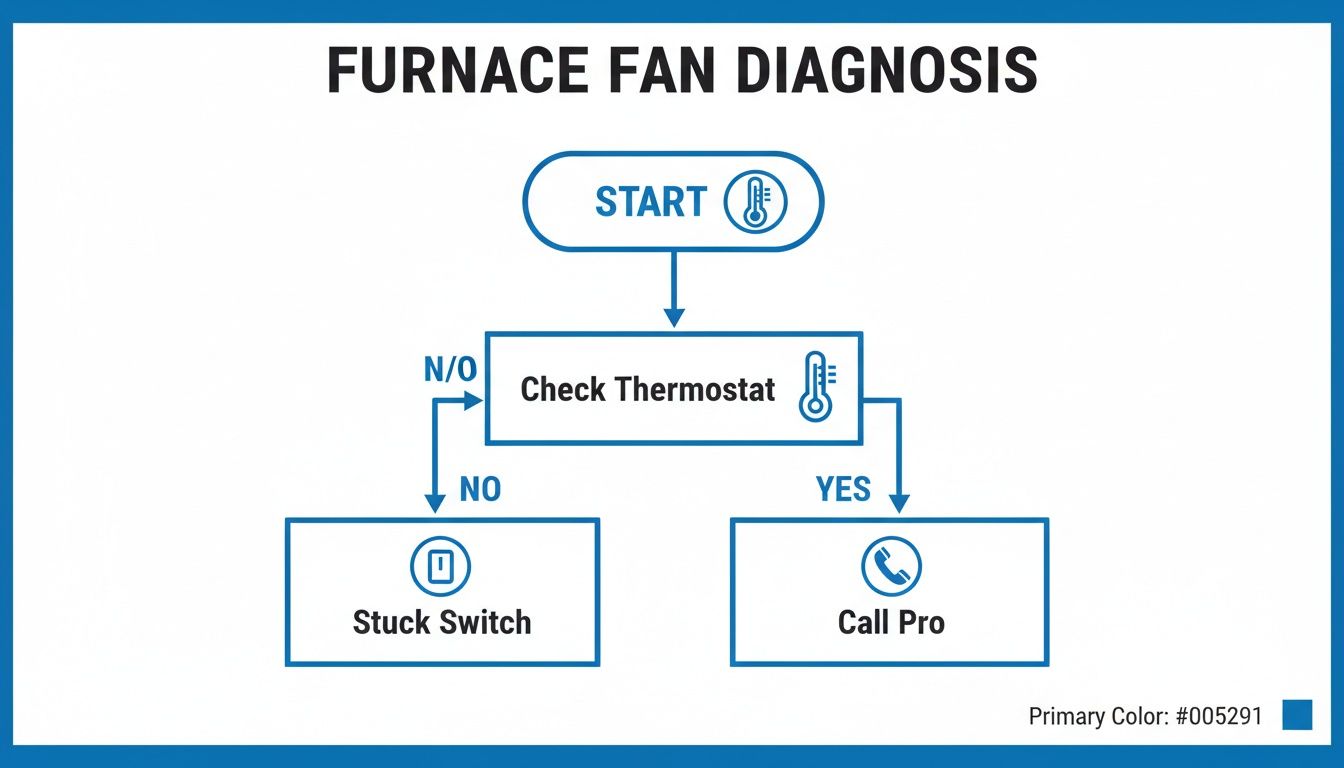
As the flowchart shows, once you've ruled out the thermostat, you're likely dealing with a component failure that needs a professional eye.
Resetting the System
After you’ve replaced the filter and done a quick visual check, it's time to see if your efforts paid off. Go ahead and restore power to the furnace—first by flipping the circuit breaker back on, then turning on the service switch.
Give the system a few minutes to reboot itself. Next, set your thermostat to "HEAT" and let it run through a full heating cycle. If the fan shuts off like it's supposed to after the house warms up, congratulations! You may have just fixed the problem.
Pro Tip: Did you hear any strange noises before this whole fan issue started? Squealing or grinding sounds could point to a problem with the blower motor itself. If that sounds familiar, check out our guide on how to fix a squeaky furnace blower motor for more details.
However, if the fan kicks right back on and stays on, you've successfully ruled out the simple fixes. At this stage, the issue is almost certainly an electrical component, like a stuck relay or a faulty limit switch. Your safest and most effective move now is to call a licensed HVAC technician.
The Real Cost to Run Your Furnace Fan Constantly

That constant hum from your furnace fan might just seem like background noise, but the real impact shows up where it hurts: your monthly utility bills and the long-term health of your HVAC system. A fan that never stops working is a fan that never stops costing you money. Let's break down what those costs actually look like, from the electricity it eats up to the parts it wears out.
Your furnace's blower motor seems small, but it’s a surprisingly power-hungry component. The average motor uses between 400 and 750 watts of electricity per hour. When it’s running 24/7 instead of just when your furnace is actually heating, those watts add up fast.
This is especially true during a long Minnesota winter. Just imagine letting that fan run non-stop in Blaine or Mora. Studies from sources like the Department of Energy show that a gas furnace blower running continuously for just 12 hours a day can burn through an extra 4.4 to 9 kWh daily. That’s a serious spike in your home’s baseline energy use.
Breaking Down the Electricity Bill
To put this into real-world terms, let’s do some quick math for a typical Central Minnesota home.
- Average Blower Motor Wattage: 500 watts (or 0.5 kilowatts)
- Hours in a Month: 720 hours
- Energy Use: 0.5 kW x 720 hours = 360 kilowatt-hours (kWh) per month
Based on Minnesota's average electricity rates, that one fan motor could add $50 or more to your monthly bill. Over a full year, you're looking at an extra $600 just to keep the fan spinning.
A fan that runs all the time is easily one of the most expensive "background" appliances in your house. It can cost more to operate annually than your refrigerator and washing machine combined, simply because it never gets a break.
The Hidden Costs Beyond Electricity
The financial hit doesn't stop with your energy bill. When you run your furnace fan constantly, you're putting every related part on the fast track to failure. This accelerated wear and tear is a major hidden cost that often blindsides homeowners with a hefty, unexpected repair bill.
Think of it like driving a car 24/7. It would need oil changes, new tires, and engine work far more often than a car used for a daily commute. Your furnace blower is no different.
Components Under Strain:
- Blower Motor: The motor itself is the main victim. Running non-stop generates constant heat and stress, which wears out the bearings and electrical windings much faster than intended. Replacing a blower motor is a significant repair, often costing several hundred dollars.
- Belts and Bearings: These moving parts are designed for intermittent use, not a marathon. The constant friction causes them to degrade, leading to those loud, squealing noises that signal they’re about to fail.
- Furnace Filters: Your filter’s job is to trap dust, pet dander, and other gunk. When the fan is always on, it's constantly pulling air—and contaminants—through that filter. You'll have to replace it far more often, maybe even monthly, just to maintain proper airflow and keep your system from choking.
When You Should Call an HVAC Professional
While I'm a big fan of homeowners tackling simple fixes, there's a definite line between a manageable DIY task and a job that needs a pro. When it comes to your furnace, messing with complex electrical parts without the right training isn't just risky—it can turn a small hiccup into a major system failure or, worse, a serious safety hazard.
Knowing when to put the tools down and pick up the phone is key.
Your own senses are surprisingly good diagnostic tools. If you catch a whiff of a burning smell coming from your vents or the furnace itself, that's a red flag. Shut the system down at the breaker immediately. That smell often means an overheating motor or melting wire insulation, both of which are serious fire risks.
The same goes for unusual noises. Sounds like grinding, squealing, or loud clanking are your furnace's way of screaming for help. These usually point to failing motor bearings or a busted blower wheel—problems that require a professional to replace specific parts.
When DIY Fixes Aren't Enough
Beyond those immediate warnings, there are other clear signs it's time to call for backup. Let's say you've already reset the furnace and swapped in a fresh filter, but that fan still won't turn off (or on). At this point, the problem is almost certainly buried deep in the furnace's electrical system.
It's time to call a licensed technician if you run into any of these situations:
- You see any visible damage like frayed, burnt, or disconnected wires inside the furnace cabinet.
- The furnace's diagnostic light is flashing an error code, and the manual isn't helping you figure it out.
- The fan issue is happening alongside spotty heating or a total failure to warm up your home.
I can't stress this enough: Trying to test or replace a fan limit switch, blower relay, or furnace control board on your own is extremely dangerous. These components are tied directly into your home's high-voltage electrical system, and a mistake can have serious consequences.
The True Cost of a Non-Stop Fan
Letting a fan run endlessly might seem like just an annoyance, but it can hit your wallet harder than you'd think. The blower motor is a real power hog—it’s responsible for about 80% of a furnace's total electricity use.
For a typical gas furnace here in Central Minnesota, a fan running for 12 hours straight can gobble up between 4.4 and 9 kWh every single day. That adds up fast on your utility bill. A professional service call doesn't just fix the immediate problem; it stops that financial bleed.
Plus, professional maintenance protects your furnace's long-term health. You can learn more about what a tune-up involves in our guide to yearly furnace maintenance.
For your peace of mind and a repair that's done safely and correctly, don't hesitate to reach out to the licensed techs at Neighborhood Plumbing, HVAC, and Electrical. We'll get it sorted out.
Furnace Fan FAQs
Even after you’ve checked the basics, it’s normal to have a few lingering questions about how your furnace fan is supposed to work. Getting a handle on the specifics can help you make smarter calls on everything from your energy bill to your family’s comfort.
We get these questions all the time from homeowners right here in Central Minnesota, so let’s clear a few things up.
Is It a Bad Idea to Run My Furnace Fan All the Time?
This is one of the most common questions we hear, and the honest answer is, "it depends." Forcing your fan to the 'ON' setting isn't necessarily bad for the furnace itself, but you're making a trade-off.
On the one hand, you get fantastic air circulation. This helps even out temperatures across your home, getting rid of those annoying hot and cold spots. It also keeps air moving through your furnace filter 24/7, which is great for trapping more dust and allergens and improving your indoor air quality.
The downside? Your electricity bill will definitely go up. You’re also putting more hours on the blower motor and its parts, which can lead to them wearing out faster. It’s really a balancing act between better air and higher running costs.
What’s the Cost to Replace a Blower Motor in Central Minnesota?
If your troubleshooting points to a dead blower motor, the replacement cost can swing quite a bit. For a standard, single-speed motor, homeowners in places like St. Cloud or Sauk Rapids should budget somewhere between $450 and $900. That range typically covers both the part and the labor to install it.
But if you have a newer, high-efficiency furnace, you likely have a variable-speed motor. These are more complex and more expensive, with replacement costs often running from $1,000 to over $2,000. The final price tag really depends on your specific furnace model and how tricky the installation is.
Can a Dirty Filter Really Make the Fan Run Nonstop?
Absolutely. In fact, it's one of the most frequent indirect causes we see. When an air filter gets completely clogged with dust and debris, it chokes off the airflow to your furnace.
This lack of air causes heat to get trapped inside the unit. Your furnace has a safety device called a high-limit switch that detects this overheating and, to protect the system, forces the blower fan to keep running to cool things down. If this happens over and over, the limit switch itself can fail and get stuck in the "on" position, leaving your fan running forever.
Key Takeaway: A simple filter change is the single most important piece of DIY maintenance you can do. It's a cheap and easy way to prevent a whole chain reaction of expensive problems, from a fried limit switch to a burned-out blower motor.
Will Running the Fan Constantly Warm Up My Cold Basement?
It can definitely help, but it's not a magic bullet. By keeping the air moving throughout your entire home, the fan will pull some of that chilly basement air upstairs and mix it with the warmer air from other levels. This can take the edge off the cold in the basement and help balance temperatures everywhere else.
However, this trick won't fix the root cause of a cold basement, like poor insulation, drafty windows, or a duct system that isn't properly balanced. Think of it as a helpful band-aid for minor temperature differences, not a permanent fix for a genuinely cold space.
If your furnace fan problem is more than just a quick filter swap or thermostat adjustment, don't wait for it to get worse. The licensed technicians at Neighborhood Plumbing, HVAC, and Electrical are here to diagnose the issue safely and get your system back to running smoothly. Visit us online to schedule your service today.