

When your furnace starts acting up, overheating, and then suddenly shutting down, it's almost always a sign of one of three things: restricted airflow from a clogged filter, a blower motor that’s on its last legs, or a faulty safety switch. This protective shutdown is actually a good thing—it’s a crucial safety feature called short cycling, and it’s designed to prevent a catastrophic failure like a cracked heat exchanger or even a fire.
Decoding Your Furnace's Cry for Help
It’s a classic Central Minnesota winter scene. The temperature plummets below zero, the wind is howling, and your furnace suddenly gives up the ghost, clicking off just minutes after it kicks on. This frustrating little hiccup is actually your furnace's built-in emergency brake, a safety mechanism that’s there to protect your home and your family.
When the internal temperature of the furnace gets dangerously high, a small but critical device called the high-limit switch trips. This immediately shuts down the whole system to prevent serious damage from happening.
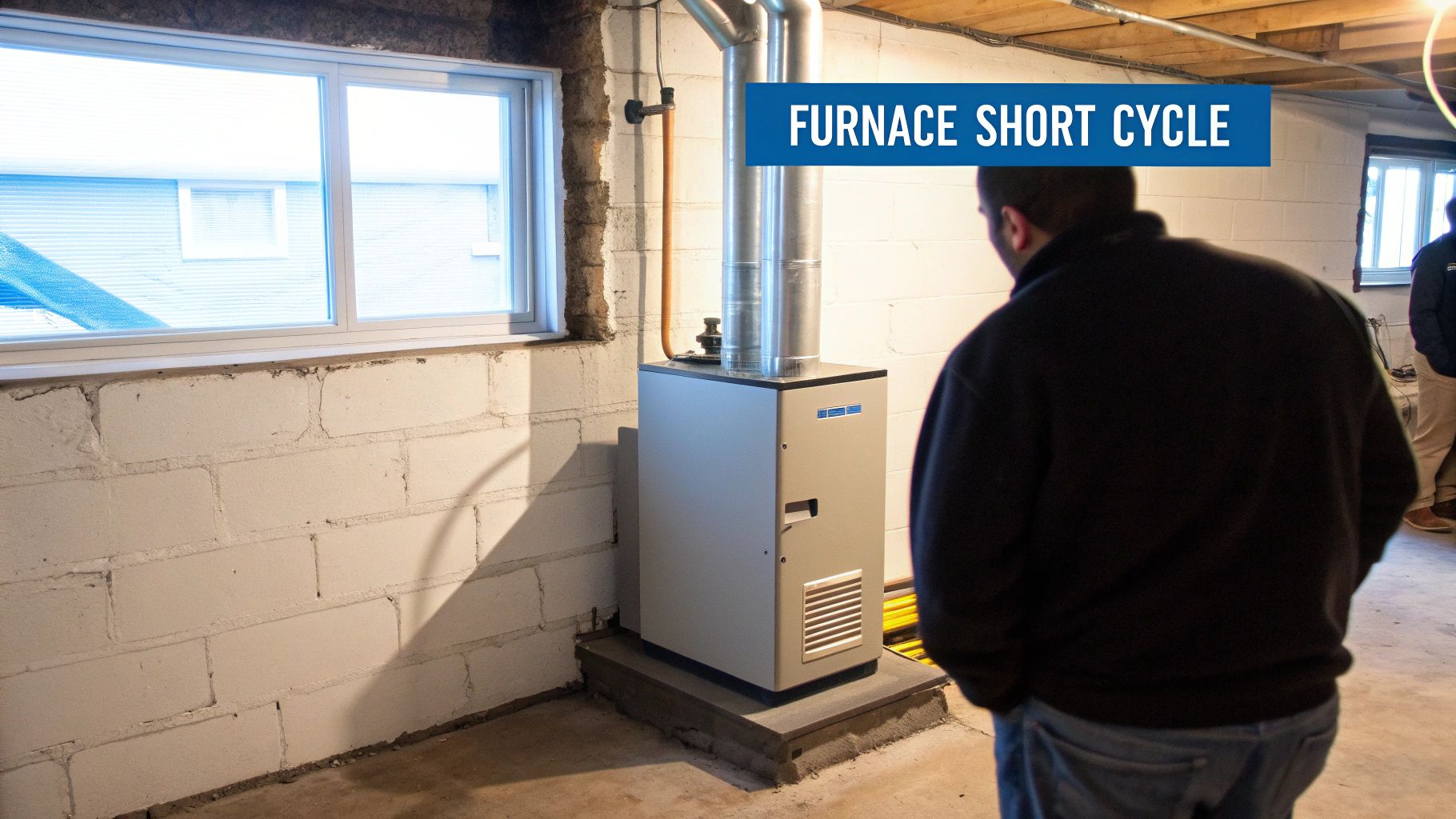
Think of it like your car's engine overheating on the highway. You wouldn't just keep driving, right? You'd pull over, let it cool down, and figure out what’s wrong. Your furnace is smart enough to do the same thing all by itself. This process protects the heat exchanger—the part that actually heats the air—from cracking under extreme stress. A cracked heat exchanger is a serious hazard because it can leak dangerous carbon monoxide gas into your home.
This exact issue is especially common around here. Picture this: it’s the dead of winter in Minnesota, temperatures have plunged to -20°F, and your furnace shuts down after running for just 3-5 minutes. This exact scenario, short cycling due to overheating, happens to countless homeowners from St. Cloud to Chisago City every year.
Poor airflow is the leading culprit, responsible for roughly 40% of all furnace shutdowns we see. When a filter gets completely clogged with dust and pet hair, the furnace can't "breathe." The trapped heat builds up until the high-limit switch is forced to step in, preventing a much more expensive and dangerous outcome. For more details on this, check out some great info on furnace run times from the team at bayareaclimatecontrol.com.
Why This Shutdown Matters
Understanding why your furnace is taking this protective measure is the first step toward finding a real solution. The primary reasons almost always trace back to one of these core problems:
- Airflow Obstructions: The furnace is essentially "suffocating" and can't push the hot air out fast enough.
- Mechanical Failure: A key component, like the blower motor, isn't doing its job right.
- Sensor Malfunctions: The safety switch itself might be faulty, triggering a shutdown when it's not actually necessary.
By recognizing that an overheating furnace is a symptom, not the root problem, you can approach troubleshooting with a lot more clarity and confidence. The system is simply telling you something is wrong before it turns into a critical failure.
Our goal here is to demystify this common headache. We'll walk through the top culprits behind the problem, empowering you to identify the cause and take the right steps to get the heat back on safely.
To get started, here's a quick reference table to help you narrow down the possibilities based on what you're seeing.
Quick Diagnosis: Common Causes of Furnace Overheating
This table is designed to give you a starting point. Match your furnace's behavior to the most likely cause and see what simple check you can perform first.
| Symptom | Most Likely Cause | Your First Step |
|---|---|---|
| Furnace runs for a few minutes, then shuts off. Repeats this cycle. | Clogged Air Filter | Turn the furnace off and inspect the air filter. Replace it if it's dirty. |
| Air from vents feels weak or cool, even when the furnace is running. | Blocked Vents/Returns | Walk through your home and make sure all supply and return air vents are open and unobstructed. |
| You hear humming or rattling from the furnace, but little air comes out. | Failing Blower Motor | This is a mechanical issue. Listen for unusual noises and call a professional for a diagnosis. |
| The furnace shuts down randomly, even when the filter is clean. | Faulty High-Limit Switch | This requires a technician to test the component safely. Do not attempt to bypass it. |
Remember, this is just a quick guide. If a simple fix like changing the filter doesn't solve the problem, it's always best to have a professional take a closer look to ensure there isn't a more serious underlying issue.
How Poor Airflow Causes Your Furnace to Overheat
Think of your furnace like a marathon runner—it needs to breathe deeply and consistently to perform. When its airway gets clogged, it can't get the air it needs and starts to overheat. This is exactly what happens inside your furnace when airflow is restricted; it essentially suffocates, leading to that frustrating cycle of the furnace overheating and shutting down again and again.
This lack of "breath" is the single most common reason a furnace short cycles, especially during a harsh Central Minnesota winter. The problem isn't that your furnace is broken; it's that it can't get rid of the intense heat it's creating. All that hot air gets trapped inside the unit, causing internal temperatures to skyrocket.
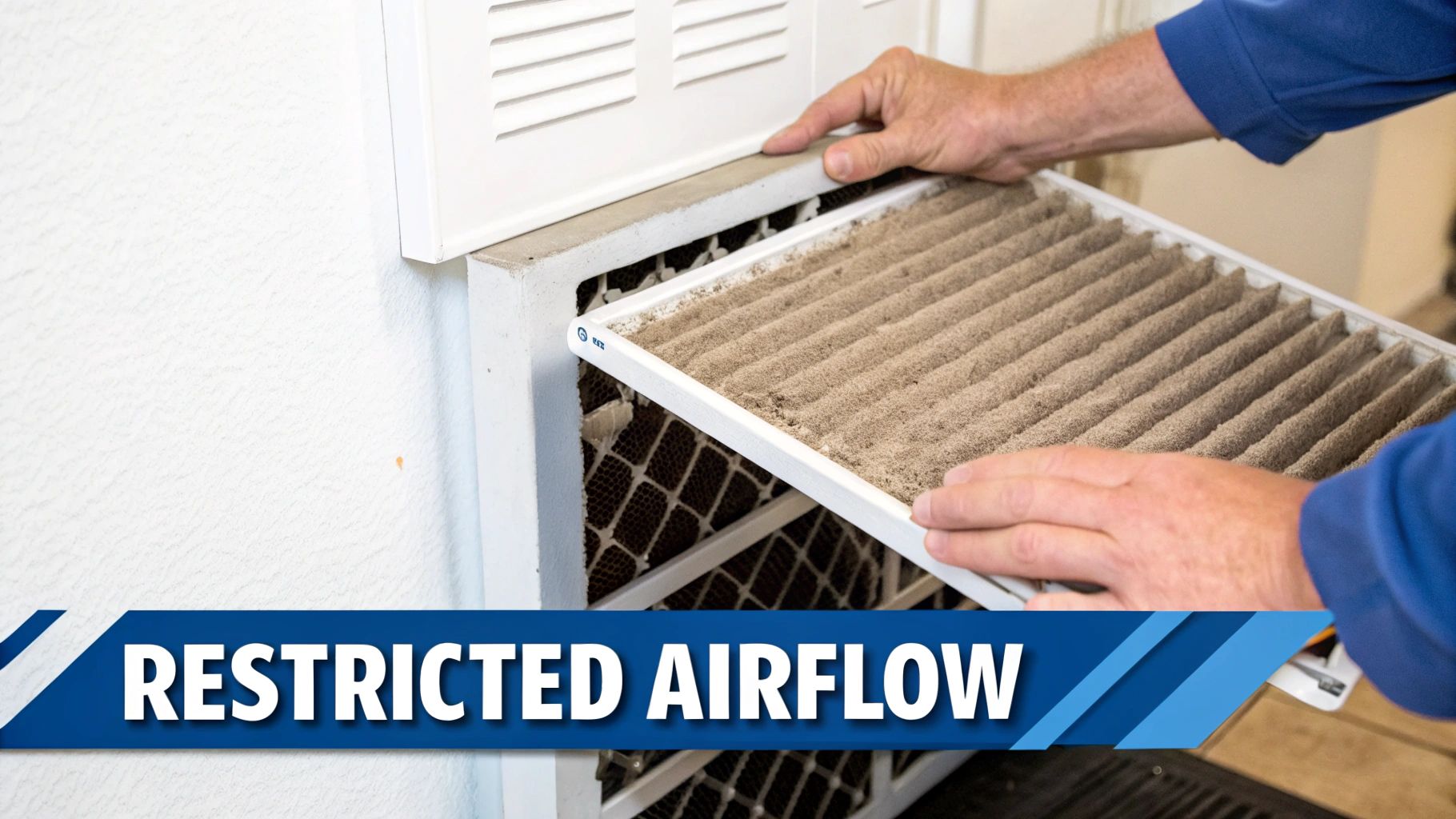
When this happens, a critical safety device called the high-limit switch acts as an emergency brake. It senses the dangerous temperature spike and immediately shuts the whole system down. It does this to prevent a cracked heat exchanger—a serious failure that could lead to a fire or a carbon monoxide leak.
The Clogged Air Filter: The Main Offender
More often than not, the culprit behind this airflow blockage is a dirty, clogged air filter. Its job is simple: to capture dust, pet dander, and other gunk before it can get inside and damage the sensitive parts of your furnace. But when it gets too full, it goes from being a protector to a barrier.
Imagine trying to breathe through a thick, dusty blanket. It's nearly impossible. That's exactly what your furnace's blower motor is up against when the filter is caked with debris. It struggles to pull in enough cool return air to push across the scorching-hot heat exchanger.
Without that steady stream of cool air to absorb and distribute the heat, the heat exchanger quickly overheats. This is why a furnace that runs for just a few minutes before shutting off often points directly to a filter that needs to be changed now. In fact, our service data shows that dirty filters alone are responsible for up to 30% of emergency repair calls during peak heating months.
A clean furnace filter is the simplest and most effective defense against overheating. Checking it monthly and replacing it every 1-3 months (or more often if you have pets or smokers) can prevent the vast majority of airflow-related shutdowns.
Blocked Vents and Dampers: The Hidden Obstructions
While the filter is always the first suspect, it's not the only thing that can choke off your furnace's breathing passages. Anything that blocks the path of air moving into or out of the furnace can cause the exact same overheating problem.
This includes both the supply registers (where warm air blows out) and the return air grilles (where cool air gets pulled in). Sometimes the cause is obvious, like a new bookshelf pushed up against a return vent. Other times, it’s a bit more hidden.
Common Airflow Blockages to Check for:
- Closed or Blocked Supply Vents: A lot of people close vents in unused rooms thinking it saves energy, but this can backfire. Closing too many vents creates backpressure, forcing the furnace to work harder and trapping heat inside. A good rule of thumb is to keep at least 80% of your home's vents open and completely clear.
- Obstructed Return Air Grilles: These are the large grilles, often in central hallways or on lower levels. Because they suck air in, they easily get blocked by furniture, rugs, laundry baskets, or even pet beds.
- Incorrectly Set Dampers: Dampers are little levers inside your ductwork that control airflow to different zones of your home. If a main damper was accidentally closed after you finished using the A/C for the summer, it can severely restrict airflow and cause the furnace to overheat.
Diagnosing these issues is pretty straightforward. Just take a quick walk through your home and eyeball every vent, register, and grille. Make sure they are all open and have at least a few inches of clear space around them. This simple five-minute check can often solve a persistent overheating problem.
Identifying Failing Mechanical and Electrical Parts
Alright, so you've checked the air filter and confirmed all your vents are open, but the furnace is still shutting down. When the easy fixes don't work, the problem usually lies a little deeper inside the unit. The next likely culprits are the hardworking mechanical and electrical parts. Over time, these components wear out, and when they do, they can’t perform their duties, causing the furnace to overheat.
Think of your furnace as a small team of specialists. If one key player can't do their job, the entire operation grinds to a halt. In this scenario, two components are the most frequent troublemakers: the blower motor and the high-limit switch.
The Overworked Blower Motor
The blower motor is the undisputed workhorse of your furnace. Its entire job is to spin a large fan (the blower wheel) that pulls cool air from your house, shoves it across the super-hot heat exchanger, and then sends that warm air out through your ducts. It’s the engine driving all the air circulation.
When a blower motor starts to fail, it can't spin the fan fast enough to move the right amount of air. It’s like trying to cool a car engine with a tiny desk fan—it just can’t keep up. The hot air ends up stagnating around the heat exchanger, causing temperatures to spike until the high-limit switch trips and shuts everything down for safety.
So, how can you tell if your blower motor is on its last legs? Listen closely when the furnace tries to kick on.
- Loud Humming or Buzzing: A loud, persistent hum that isn't the normal sound of air moving often means the motor is getting power but is struggling to turn.
- Grinding or Squealing Noises: These awful sounds almost always point to worn-out bearings inside the motor. That friction is a clear sign that failure is just around the corner.
- A Burning Smell: A sharp electrical or metallic burning odor is a serious red flag. It can mean the motor itself is overheating, creating a fire hazard that requires you to shut the system down immediately and call a professional.
A healthy furnace should operate with a consistent, gentle whoosh of air. Any new, loud, or metallic sounds are your furnace’s way of telling you a critical mechanical part is in distress and needs professional attention.
When the Safety Switch Itself Fails
Sometimes, the very part designed to protect your furnace becomes the problem. The high-limit switch is a simple but vital sensor that keeps an eye on the internal temperature. If it gets too hot, the switch cuts power to the burners. But what happens when this sensor starts giving bad information?
A faulty high-limit switch can become overly sensitive, tripping and shutting the furnace down even when the temperature is perfectly fine. It's like a smoke detector that goes off every time you make toast. The system isn't actually in danger, but the malfunctioning sensor thinks it is and acts accordingly. This can happen from old age, a layer of dirt on the sensor, or just plain electrical failure.
Another related part to keep in mind is the flame sensor. While it doesn't cause overheating directly, a dirty or bad flame sensor can also make your furnace shut off unexpectedly. You can learn more by reading our guide on where the flame sensor is on a furnace.
Unfortunately, diagnosing a bad high-limit switch isn’t a simple DIY job. It requires a technician with a multimeter to test the component and confirm if it’s tripping at the correct temperature. Trying to bypass or mess with this switch is incredibly dangerous, as it removes the main safety feature protecting your home from a catastrophic furnace failure. If you suspect a faulty switch, the only safe move is to call for professional service.
Your Safe DIY Furnace Troubleshooting Checklist
When your furnace quits on a freezing Central Minnesota night, it’s easy to feel a jolt of panic. But before you reach for the phone, take a deep breath. Many times, the reason a furnace is overheating and shutting down is something you can safely and easily fix yourself.
This checklist is designed to walk you through the most common culprits, starting with the simplest checks first. The goal here is to confidently rule out the easy stuff. More often than not, overheating issues are caused by minor, easily correctable problems that don't require a service call.
1. The Essential First Step: Check Your Thermostat
Your thermostat is the brain of your entire heating system, and if it's not communicating correctly, nothing else will work right. Before you even get near the furnace itself, start here.
First, make sure the thermostat is actually set to "HEAT" and the fan is on "AUTO." If the fan is set to "ON," it will blow air constantly, even when the furnace isn't actively heating, which can sometimes hide other problems. Also, double-check that the temperature you've set is higher than the current room temperature.
Finally, what about the batteries? Low batteries can cause all sorts of strange behavior, like sending bad signals that tell your furnace to shut down. Most modern thermostats have a low-battery light, but it’s always a good idea to pop in a fresh pair just to be sure. It's a simple step that solves more issues than you'd think.
2. Inspect the Lifeblood of Your System: The Air Filter
If the thermostat settings are correct, your very next stop should be the furnace air filter. As we've mentioned, a clogged filter is the #1 cause of furnace overheating. It literally suffocates your system, blocking airflow and causing the internal temperature to spike until a safety switch shuts everything down.
To check it, first, kill the power to your furnace. There should be a switch on or near the unit, but you can also use your home's circuit breaker to be safe. Once the power is off, slide the filter out of its slot and hold it up to a light. Can't see the light through it? It’s toast.
Slide a new, clean filter in its place. Just be sure the arrows printed on the filter's frame are pointing in the direction of airflow—that's usually toward the furnace's blower motor. This quick, five-minute job can instantly get your heat back on. If you need a little more guidance, our article on how to troubleshoot a furnace that won't start has some extra tips.
3. Clear the Path for Airflow
With a fresh filter installed, it's time to make sure air can actually move freely through your house. Take a quick walk through every room and give your air vents a look.
- Supply Vents (where warm air blows out): Are they all open? Make sure they aren't blocked by furniture, rugs, or curtains. It might seem smart to close vents in rooms you don't use, but doing so can create backpressure that traps heat and forces the furnace to overheat.
- Return Vents (where air is sucked in): These are the bigger grilles, and they often get blocked by bookshelves, couches, or laundry baskets. Make sure they have at least several inches of clear space around them.
This quick tour ensures your furnace isn't fighting against a blocked airway just to do its job.
The noises your furnace makes can also give you clues about what's going on inside. This flowchart is a handy way to figure out what those sounds might be telling you.
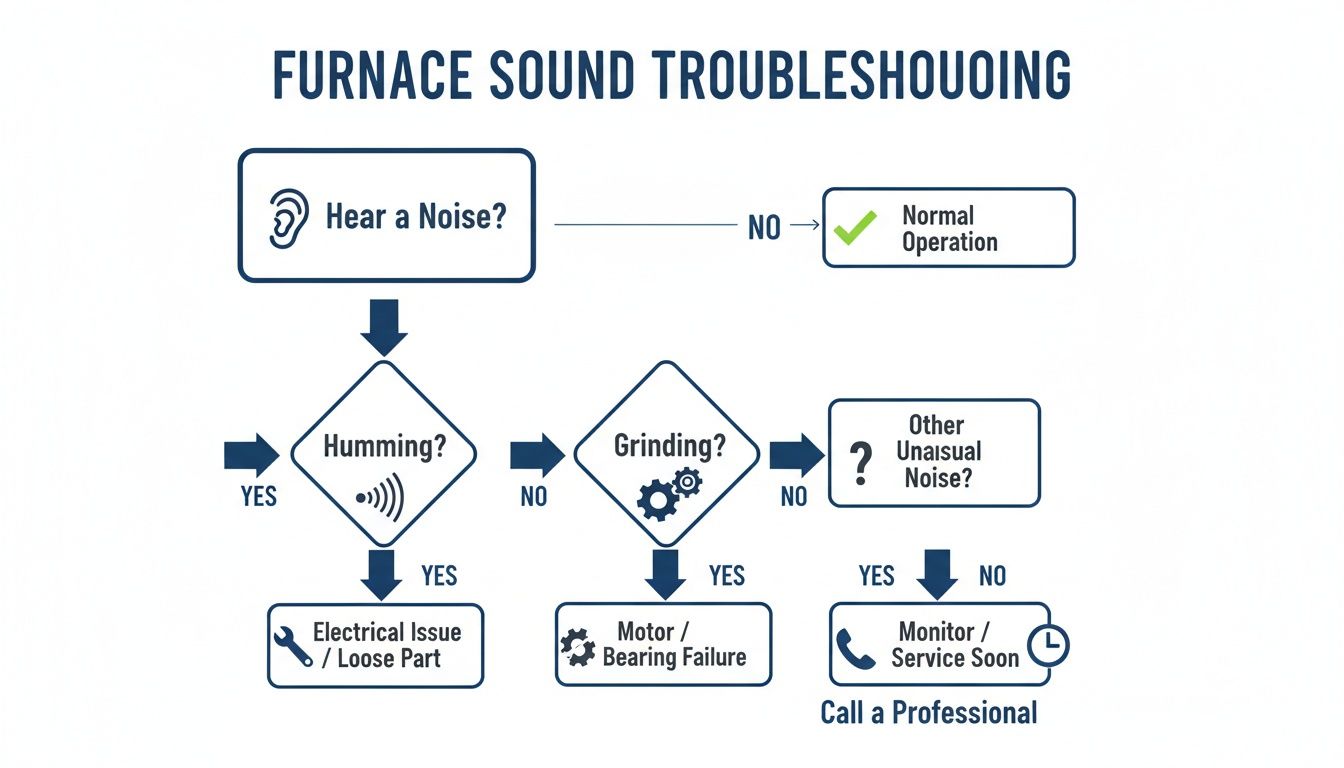
As you can see, a humming sound points to a very different problem than a grinding one, helping narrow down whether it’s an electrical issue or a mechanical failure.
4. Check Outdoor Vents for Blockages
Here in Central Minnesota, snow and ice are notorious for causing furnace problems. If you have a high-efficiency furnace, you'll see two plastic PVC pipes running from the unit to the outside of your house. One is the intake, which pulls in fresh air for combustion, and the other is the exhaust.
Safety First: If you smell gas or think you might have a carbon monoxide leak (symptoms include headaches, dizziness, or nausea), get everyone out of the house immediately. From a safe distance, call 911 and then your utility company. Do not try any more troubleshooting.
From the ground, take a look at where these pipes exit your home. Drifting snow, ice buildup from a thaw-and-refreeze, or even a bird's nest can completely block them. If an obstruction is found, the furnace's pressure switch will detect it and shut the whole system down to keep dangerous exhaust from venting into your home. Carefully clear away any snow, ice, or debris to restore proper airflow.
Homeowner Furnace Safety Checklist
Knowing what you can safely check yourself versus when to call a professional is key. This table breaks down the diagnostic steps to help you make the right call.
| Diagnostic Check | Safety Level (DIY or Professional) | Action Required |
|---|---|---|
| Thermostat Settings & Batteries | DIY | Check settings are on "HEAT" and "AUTO." Replace batteries. |
| Air Filter Inspection | DIY | Turn off power, inspect the filter, and replace if dirty. |
| Vents & Registers | DIY | Ensure all supply and return vents are open and unobstructed. |
| Outdoor Vent Pipes | DIY | Visually inspect for snow, ice, or debris blockages and clear if safe to do so. |
| Ignitor or Pilot Light Issues | Professional | If the ignitor isn't glowing or the pilot is out and won't relight, call for service. |
| Blower Motor Problems | Professional | Grinding, squealing, or a motor that won't run requires a technician. |
| Limit Switch Malfunction | Professional | If the furnace cycles off too quickly even with clear airflow, the switch may be faulty. |
| Gas Smell or CO Detector Alarm | IMMEDIATE EVACUATION | Leave the house immediately, then call 911 and your utility company. |
By following these simple, safe DIY steps, you can often solve the problem yourself. But if you’ve run through the list and the heat still isn’t on, it’s time to let a professional take over.
Proactive Maintenance to Prevent Future Overheating
The best way to handle a furnace that overheats and shuts down is to stop it from happening in the first place. Instead of dealing with a cold house in the middle of a Minnesota winter, proactive maintenance flips the script from reactive repairs to preventative care. This isn't just about dodging an emergency; it's an investment in your furnace's long-term health, efficiency, and reliability.
Think of it like getting regular oil changes for your car. You don't wait for the engine to seize up—you perform routine service to keep it humming along. An annual professional furnace tune-up does the exact same thing, catching and fixing small issues before they snowball into a total system failure that leaves you without heat.
What a Professional Tune-Up Involves
A comprehensive annual tune-up is way more than just swapping out a filter. It's a deep-dive inspection and cleaning that gets to the root causes of overheating. When a licensed Neighborhood technician services your system, they run through a series of critical checks designed to get your furnace back to peak condition.
Key tasks include:
- Cleaning the Blower Wheel: Over time, the blower wheel's blades get caked with dust and grime, making it harder to move air. A thorough cleaning ensures the motor doesn't have to overwork itself, which prevents strain and overheating.
- Inspecting the Heat Exchanger: This is arguably the most critical safety check of the entire visit. The technician will carefully inspect the heat exchanger for any signs of cracks or stress that could lead to dangerous carbon monoxide leaks.
- Testing Safety Controls: Every safety feature, including the high-limit switch, gets tested to make sure it's working correctly and will shut the system down when it's supposed to.
- Tightening Electrical Connections: Loose wiring can cause all sorts of funky power issues and is a potential fire hazard. Securing every connection ensures your system operates safely and reliably.
A professional tune-up is a top-to-bottom health check for your heating system. It’s the single best action you can take to prevent a furnace from overheating and shutting down when you need it most.
This annual service does more than just prevent breakdowns. A clean, well-tuned furnace uses less energy to heat your home, which you'll see reflected in your monthly heating bills. It also significantly extends the life of your equipment, pushing back the day you'll need a costly replacement. You can learn more about how this works by checking out our guide on how maintenance can prevent a furnace repair.
Your Simple Seasonal Maintenance Schedule
While a professional tune-up is non-negotiable, there are a few simple things you can do yourself throughout the year to keep your system happy. Tacking these onto your regular home maintenance routine helps lock in the benefits of your annual service.
Homeowner's Maintenance Checklist:
- Check the Filter Monthly: During the heavy heating season (think October through March), give your air filter a look every 30 days and replace it if it's dirty. This is your number-one defense against airflow problems.
- Keep the Area Clear: Make sure the space around your furnace is free of clutter, dust, and anything flammable. A three-foot clearance is the standard rule of thumb to ensure it can breathe properly.
- Test Carbon Monoxide Detectors: Push the "test" button on your CO detectors every month and swap out the batteries at least once a year. This is a crucial safety step for any home with a fuel-burning appliance.
By combining an annual professional inspection with these easy homeowner tasks, you build a powerful defense against the very issues that cause a furnace to overheat. This proactive approach gives you peace of mind, knowing your system is safe, efficient, and ready for whatever a Central Minnesota winter decides to throw at it.
When It's Time to Call an HVAC Professional
Look, running through a DIY checklist can often get your furnace back on track. But some symptoms are more than just a minor hiccup—they're your furnace's emergency signals. When you see, hear, or smell them, it's time to stop troubleshooting and call a licensed professional immediately. Your family's safety is always the right call.
Certain red flags point to a problem that goes way beyond a simple fix. Trying to tackle these issues yourself isn't just a bad idea; it can be downright dangerous, risking fire, electrical shock, or exposure to hazardous gases like carbon monoxide.
Critical Warning Signs to Watch For
If you run into any of the following, shut your furnace off at the breaker and call a trusted HVAC company like Neighborhood Plumbing, HVAC, and Electrical right away. These are non-negotiable signs that you need an expert's help.
- You Smell Gas or Burning Plastic: A rotten egg smell is the classic sign of a potential gas leak. If you smell burning plastic or a hot electrical odor, it could mean a motor is about to seize up or wiring is failing. Both are immediate fire hazards.
- Loud Banging or Metallic Scraping Noises: A healthy furnace hums along quietly; it definitely doesn't bang or screech. Loud, violent noises often mean a critical internal part, like the blower wheel or a motor mount, has broken and is literally tearing itself apart inside the unit.
- The Furnace Still Shuts Down After Basic Checks: So you've replaced the filter and walked the house to confirm all your vents are clear, but the furnace still keeps short cycling. This tells you the problem lies deeper. It's likely a failing component like a blower motor or a faulty high-limit switch that needs a pro to diagnose.
- Your Carbon Monoxide Detector Goes Off: This is the most serious warning of all. Get everyone out of your home immediately and call 911 from a safe location. A CO alarm is a life-threatening emergency and often means your furnace's heat exchanger has a deadly crack.
Never second-guess a serious warning sign. The risk of fire, major equipment damage, or carbon monoxide exposure is far too great. When in doubt, shut the system down and let a professional diagnose the problem safely.
The Value of Professional Expertise
Calling a certified technician from a trusted local company isn't just about getting a repair; it's about peace of mind and ensuring your family's long-term safety and comfort. Our licensed technicians show up with specialized diagnostic tools that can pinpoint complex issues most DIY checks would never uncover.
For example, we can accurately test a high-limit switch to see if it's tripping at the correct temperature or use a combustion analyzer to check for microscopic, dangerous cracks in the heat exchanger. We also understand the specific challenges Central Minnesota winters throw at a heating system and can make sure your unit is truly ready for the fight.
Ultimately, calling for professional help means you get a correct diagnosis, a safe repair backed by a warranty, and the assurance that your furnace will run reliably through the coldest nights of the year. If you're dealing with a furnace that keeps overheating and shutting down, don't wait for the problem to get worse—call Neighborhood for fast, expert service.
Your Top Furnace Overheating Questions Answered
When your furnace acts up in the middle of a Minnesota winter, you’ve got questions, and you need answers fast. Here are some of the most common things homeowners ask us when their heat goes out.
How Often Should I Really Change My Furnace Filter in Minnesota?
During our long and brutal Central Minnesota heating season—think October all the way through March—you need to be checking that filter monthly. It sounds like a lot, but it’s your number one defense.
Standard one-inch filters might last one to three months on paper, but that's in an ideal world. If you've got pets shedding fur, anyone who smokes, or even just dust from a recent home project, you should be swapping that filter out every 30 days. No exceptions. It's the simplest and cheapest way to keep your furnace breathing easy.
Let me put it this way: The most common reason we get called for an overheating furnace is a dirty, clogged filter. Spending $20 on a new filter can save you from a several-hundred-dollar emergency repair call. It is, without a doubt, the most cost-effective maintenance you can do.
Is It a Big Deal If My Furnace Keeps Shutting Off?
Yes, it's a very big deal. While the furnace shutting down means its safety features are working, it's also a blaring red flag. That shutdown is preventing an immediate catastrophe like a fire or a cracked heat exchanger, which could leak deadly carbon monoxide into your home.
Think of it like the check engine light in your car. The car still drives, but you know something is seriously wrong under the hood. Ignoring the reason your furnace is overheating is just asking for a complete system failure, and it puts your home and family at risk.
Can a Bad Thermostat Make My Furnace Overheat?
That's a common thought, but no, a faulty thermostat won't cause your furnace to actually overheat. It might cause other headaches, like telling your furnace to turn on and off at the wrong times (short cycling), but it doesn't control the internal temperature of the unit itself.
Overheating is almost always an internal problem, usually tied to restricted airflow or a failing mechanical part like the blower motor. If you've already swapped the filter and made sure all your vents are open, the issue is deeper inside the furnace. That’s your cue to call in a professional.
If you've gone through the DIY checklist and your furnace is still on the fritz, don't gamble with your family's safety and comfort. The licensed technicians at Neighborhood Plumbing, HVAC, and Electrical are on standby to figure out what's wrong and get your heat back on, day or night. Contact us 24/7 for expert furnace repair.