

When the heat quits in the middle of a Minnesota winter, figuring out is my furnace gas or electric is the first thing you need to do. It’s a simple question, but the answer dictates your next steps. Most homes around here have gas furnaces, which use a flame to generate heat. Electric models, on the other hand, work more like a giant toaster with big heating elements.
The quickest way to tell? Look for a metal exhaust pipe leaving the furnace. If you see one, it’s almost certainly a gas unit.
Your Quick Guide for Minnesota Homes
Knowing your furnace type is crucial before you even think about calling for service or trying to troubleshoot. Here in Minnesota, where our heaters are non-negotiable for a good chunk of the year, a fast, accurate ID can save you a ton of time and make sure you get the right technician out to your home. Think of this as your rapid diagnostic tool to get you pointed in the right direction.
The choice between gas and electric often boils down to running costs. There's a reason natural gas systems dominate the market—heating with natural gas can be 30-50% cheaper per unit of energy than electricity in many areas.
Key Takeaway: The most immediate difference is how they create heat. Gas furnaces burn fuel, which creates exhaust that has to be vented outside through a pipe. Electric furnaces don't burn anything, so they don't produce exhaust and don't need a vent pipe.
To help you quickly spot the differences, here’s a simple comparison chart. Just a quick glance at your unit and you should be able to make a confident call.
Gas vs. Electric Furnace Quick Identification Chart
| Identifying Feature | Gas Furnace Clues | Electric Furnace Clues |
|---|---|---|
| Exhaust Vent | Metal pipe (flue) leading outside | No exhaust pipe present |
| Sound | A distinct "whoosh" or "rumble" when burners ignite | A quiet "click" followed by the hum of the blower fan |
| Visuals | Visible burners, a pilot light (on older models), or electronic igniter | Looks like a simple metal cabinet with wiring; may have heating coils visible inside |
| Fuel Source | A gas shutoff valve and pipe leading to the unit | A thick, heavy-gauge electrical cable leading to a dedicated circuit breaker |
This table covers the most common tells, but let's dig a little deeper into what you should be looking and listening for.
Visual and Auditory Clues
Start with your eyes and ears—it’s the easiest first step. Does your furnace make a distinct "whoosh" sound when it kicks on? That's the unmistakable sound of gas burners firing up. An electric furnace is much quieter in comparison, usually just making a soft click followed by the steady hum of the blower fan.
Our guide to comparing heating system types goes into more detail on the pros and cons of each. And if you want to understand the broader world of electric heating, this resource offers a great reverse cycle air conditioning explained guide.
2. Decode Your Furnace With a Few Visual Clues
Most of the time, solving the gas vs. electric furnace mystery is easier than you think. You can put on your detective hat and figure it out with a quick visual inspection—no special tools required.
The single most telling sign is an exhaust pipe, often called a flue. A gas furnace creates combustion byproducts, and those fumes have to be vented safely outside your home. Look for a metal pipe (usually galvanized steel) or even a white PVC pipe running from the top or side of your furnace unit straight out through a wall or your roof.
If you see one, that's your answer. You have a gas furnace. No exceptions.
This simple chart breaks down the core difference.
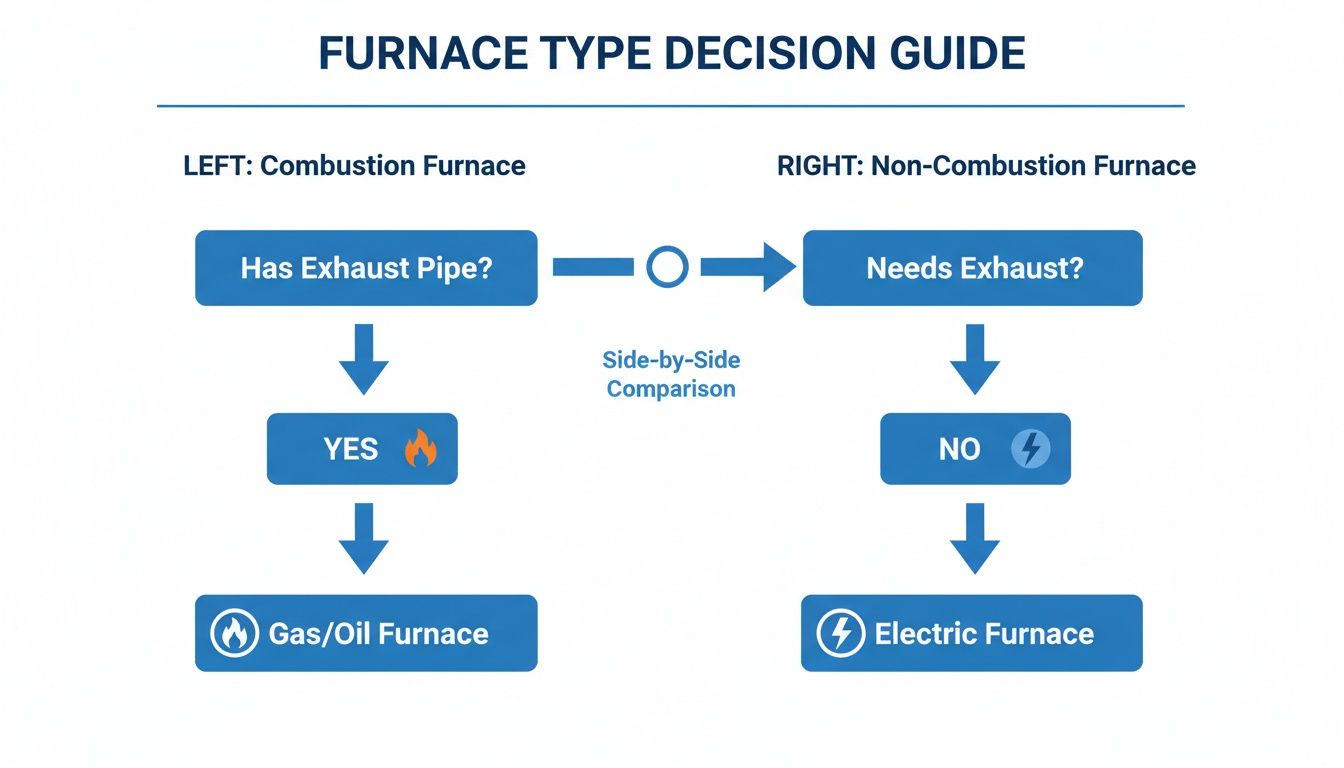
As you can see, that flue pipe is the number one visual giveaway separating gas and electric models.
Find the Gas Supply Line
Another dead giveaway for a gas furnace is the gas line itself. This is almost always a black iron pipe that connects your home's main gas line directly to the furnace. Follow that pipe, and you'll find a shutoff valve with a handle, usually painted bright yellow or red for visibility. This lets you cut off the gas supply in an emergency.
An electric furnace, on the other hand, won't have any gas piping connected to it. Instead, you'll spot a thick, heavy-duty electrical cable running into the unit, often protected by a flexible metal conduit. That beefy cable is needed to handle the high electrical load required to power the heating elements.
Pro Tip: Peek through any vents or access panels on your furnace cabinet. If you can see a row of ribbon-like burners or a small, steady blue flame (that's a pilot light), you're definitely looking at a gas system. You can learn more about how to identify a furnace flame sensor in our related guide.
Look for the Blue Flames
When your thermostat calls for heat, a gas furnace ignites its burners. Many models have a small viewport or slotted panel so you can see what's happening inside. You might see an electronic igniter glow bright orange for a moment, followed by a row of blue flames kicking on along the burners.
Seeing that flame is definitive proof. Electric furnaces don't have flames; they rely on electric coils that glow red-hot, much like the inside of a toaster.
Gas heating is a powerhouse, not just in homes. The global industrial furnaces market recently hit $12.16 billion, with gas systems commanding over 54% of that share thanks to their ability to generate intense heat.
Uncovering Clues on Labels, Breakers, and Utility Bills
If the obvious visual signs like exhaust pipes aren't giving you a clear answer, don't worry. Your home’s own documentation and electrical system hold the definitive proof to solve the is my furnace gas or electric mystery. These next steps involve a bit of simple detective work with labels, breakers, and bills.
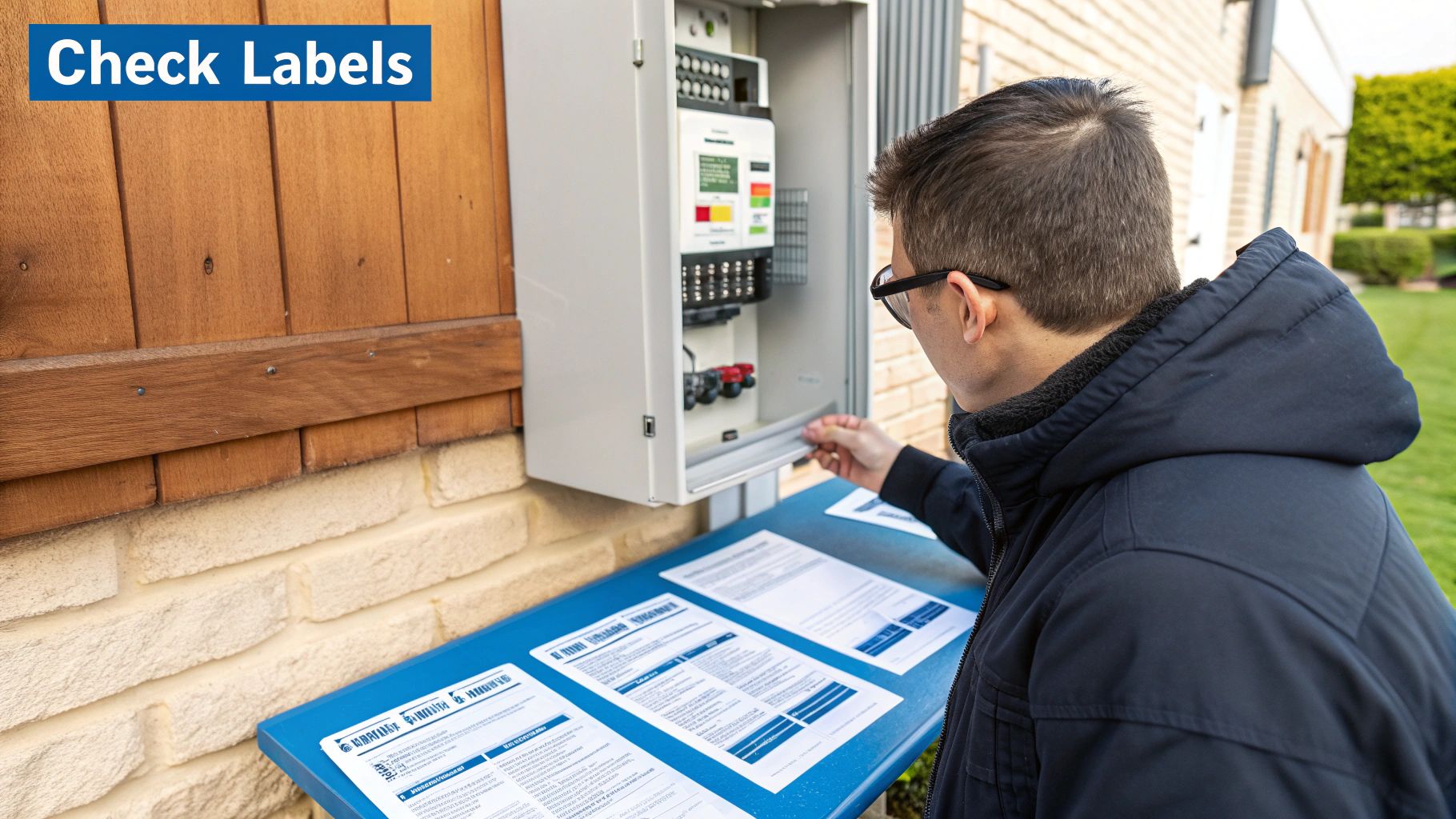
Your first stop should be the manufacturer’s data plate, which is a metal label stuck directly onto your furnace cabinet. Look for terms like "Input BTU" (British Thermal Units). BTUs measure gas consumption, so seeing that is a sure sign of a gas furnace.
On the other hand, if you see ratings in "kW" (kilowatts), that confirms you have an electric unit. Kilowatts measure electrical power, not gas.
Check the Electrical Panel
Next, head to your home’s main circuit breaker panel. An electric furnace is a power-hungry appliance and requires a substantial, dedicated circuit to operate safely. It’s one of the clearest giveaways.
- Electric Furnace Clue: Look for a large, double-pole breaker. This breaker is twice as wide as a standard one and often has two switches linked together. It will be labeled with a high amperage, typically 60A or even higher.
- Gas Furnace Clue: A gas furnace only needs a small amount of power for its fan and electronics. It will connect to a standard, single-pole breaker that looks like most others in your panel, usually rated at 15A or 20A. Our guide on whether a gas furnace uses electricity explains this in more detail.
When you're looking at your home's electrical panel, those large, dedicated breakers are a key indicator of an electric furnace. For any complex issues you spot, it's always smart to consult an expert in residential breakers and panels.
Safety First: Always exercise caution when opening your electrical panel. Never touch any wires or terminals. If you're unsure about what you're looking at, it's always best to close the panel and consult a professional.
Review Your Utility Bills
Finally, the easiest clue of all might be hiding in your mailbox or email inbox. Pull out a utility bill from a cold winter month like January or February.
If you see a significant charge for natural gas usage (measured in therms or cubic feet), you almost certainly have a gas furnace. But if your electricity bill skyrockets during the winter while your gas usage stays low, that’s a clear sign of an electric furnace doing the heavy lifting.
Why Knowing Your Furnace Type Matters
Figuring out if your furnace is gas or electric is about more than just satisfying your curiosity. It’s one of those little pieces of homeowner knowledge that has a real impact on your budget, your family’s safety, and how you keep the system running through a Minnesota winter.
For most people, the first thing that comes to mind is cost. Let's be honest, the monthly expense to run a gas furnace is often a lot lower than an electric one, especially when the temperatures drop and the heat is running almost nonstop. Knowing which fuel your furnace uses helps you make sense of your utility bills and plan your budget.
Safety and Maintenance Are Not One-Size-Fits-All
The safety rules and maintenance needs for gas and electric systems are completely different. Since a gas furnace actually burns fuel, it creates byproducts like carbon monoxide. That’s why a working carbon monoxide detector is an absolute, non-negotiable must-have in any home with a gas furnace.
Electric furnaces don't burn fuel, so they don't carry that specific risk. Their maintenance checklist is totally different, too, which affects who you call for a tune-up and what they’ll actually do.
- Gas Furnace Tune-Up: A tech will need to inspect the burners, clean out the heat exchanger, and check for any signs of a gas leak.
- Electric Furnace Tune-Up: This involves checking the heating elements (the coils), making sure electrical connections are tight, and inspecting the sequencer.
Knowing your furnace type from the get-go means you can schedule the right kind of service. It saves you from a wasted trip fee and gets your heat back on faster. It also lets you ask smarter questions when you get a repair estimate.
Making Smarter Decisions for the Long Haul
Ultimately, knowing your furnace type helps you be a more informed homeowner. You’ll have a better idea of what to expect for repair costs and what to look for when it’s eventually time to replace the whole system.
While gas furnaces are still very common, it's interesting to see how the market is shifting. The global heat furnace market was valued at $9.12 billion, and it's the electric models that are seeing the fastest growth, mainly because of their efficiency and better temperature control. You can dig into these market trends to get a better sense of what future heating options might look like.
When to Call a Licensed HVAC Technician
Figuring out if your furnace is gas or electric is a great first step, but knowing when to step back and let a professional take over is even more critical. Some situations just aren't DIY-friendly, especially with the complex systems packed into many older Minnesota homes.
Trying to tackle a complex furnace repair on your own isn't just risky—it can also void your furnace’s warranty. For any actual repair work, annual maintenance, or a full system replacement, calling a pro is non-negotiable. It’s the only way to ensure the job is done safely and correctly, protecting both your family and your investment.
Clear Red Flags Demanding a Professional
Some symptoms are your furnace’s way of screaming for help. If you notice any of the following, it’s time to turn off the system and call for service right away.
- You smell gas: A rotten egg smell near your gas furnace is a serious warning. Leave your home immediately, and once you're a safe distance away, call your gas utility company. Don't touch any light switches or electronics on your way out.
- Loud, unusual noises: Banging, screeching, or harsh metallic sounds are never good. These can point to major mechanical failures, like a failing blower motor or, even worse, a cracked heat exchanger.
- Visible soot or scorch marks: If you see black soot collecting around your furnace vents, it’s a sign of incomplete combustion. This is dangerous because it can release carbon monoxide into your home.
Crucial Safety Note: Never ignore these warning signs. A problem like a cracked heat exchanger in a gas furnace is a serious health hazard that can leak deadly carbon monoxide into your living space.
Another tell-tale sign is if your furnace constantly turns on and off. We call this short cycling, and it points to a deeper issue that a technician needs to diagnose. While identifying your furnace type is a great starting point, trusting a pro for the hands-on work is what will keep your system running safely and efficiently all winter long.
Still Have Questions? We’ve Got Answers
Once you’ve cracked the code and figured out whether your furnace is gas or electric, you might still have a few things rattling around in your head. That's totally normal. Understanding the little details helps you run your system safely and efficiently.
Here are some of the most common questions we get from homeowners, answered straight from our experience in the field.
Does a Pilot Light Automatically Mean I Have a Gas Furnace?
Yes, it sure does. If you see a small, steady blue flame inside your furnace, that's a pilot light, and it’s a dead giveaway you have an older gas furnace. That little flame’s only job is to ignite the main burners when your thermostat tells the system it's time to heat things up.
Newer gas furnaces have moved on to more efficient electronic ignition systems, so you won't see a pilot light on modern units. But if you spot that constant flame, there’s no doubt about it—you're dealing with gas. Electric furnaces just don't have flames because they use heating elements instead.
Can My Furnace Be Gas if My House Isn't Hooked Up to a Gas Line?
This is a great question and one that trips people up all the time. If your home isn't connected to the local natural gas utility, you can't have a natural gas furnace. Simple enough, right?
But you might have a furnace that runs on propane, also called LP gas. Propane is stored in a big tank on your property and works almost exactly like natural gas inside the furnace. You'll still see all the classic signs of a gas system, like an exhaust flue and burners. So, if you see that big tank outside but the furnace itself looks like a gas model, it's almost certainly powered by propane.
Key Takeaway: Both furnace types are designed with robust safety features and are extremely safe when installed and maintained correctly by a professional. The key is regular, professional service.
Which Is Safer, an Electric or a Gas Furnace?
Both systems are built to be incredibly safe, but they have different safety profiles. The main advantage of an electric furnace is that it eliminates the risk of carbon monoxide (CO) poisoning because it doesn't burn any fuel.
Gas furnaces, on the other hand, come loaded with safety features like pressure switches and flame sensors to shut things down if something goes wrong. The single most important thing you can do for safety with a gas furnace is to install carbon monoxide detectors and test them regularly. Ultimately, the safety of either system comes down to proper installation and consistent professional maintenance.
If you're still not sure what kind of furnace you have, or if you just want the peace of mind that comes with a professional tune-up, the licensed technicians at Neighborhood Plumbing, HVAC, and Electrical are here to help. Schedule your service today and stay warm and safe all winter long.