

Figuring out the best furnace thermostat settings isn't just about picking a number you like. A simple setback strategy can work wonders. I always tell homeowners to aim for 68°F when you're home and awake, then drop it by 7-10°F when you’re asleep or away. This small adjustment is the secret to staying comfortable while saving a surprising amount on your heating bills during a harsh Minnesota winter.
Finding Your Ideal Furnace Settings in Minnesota
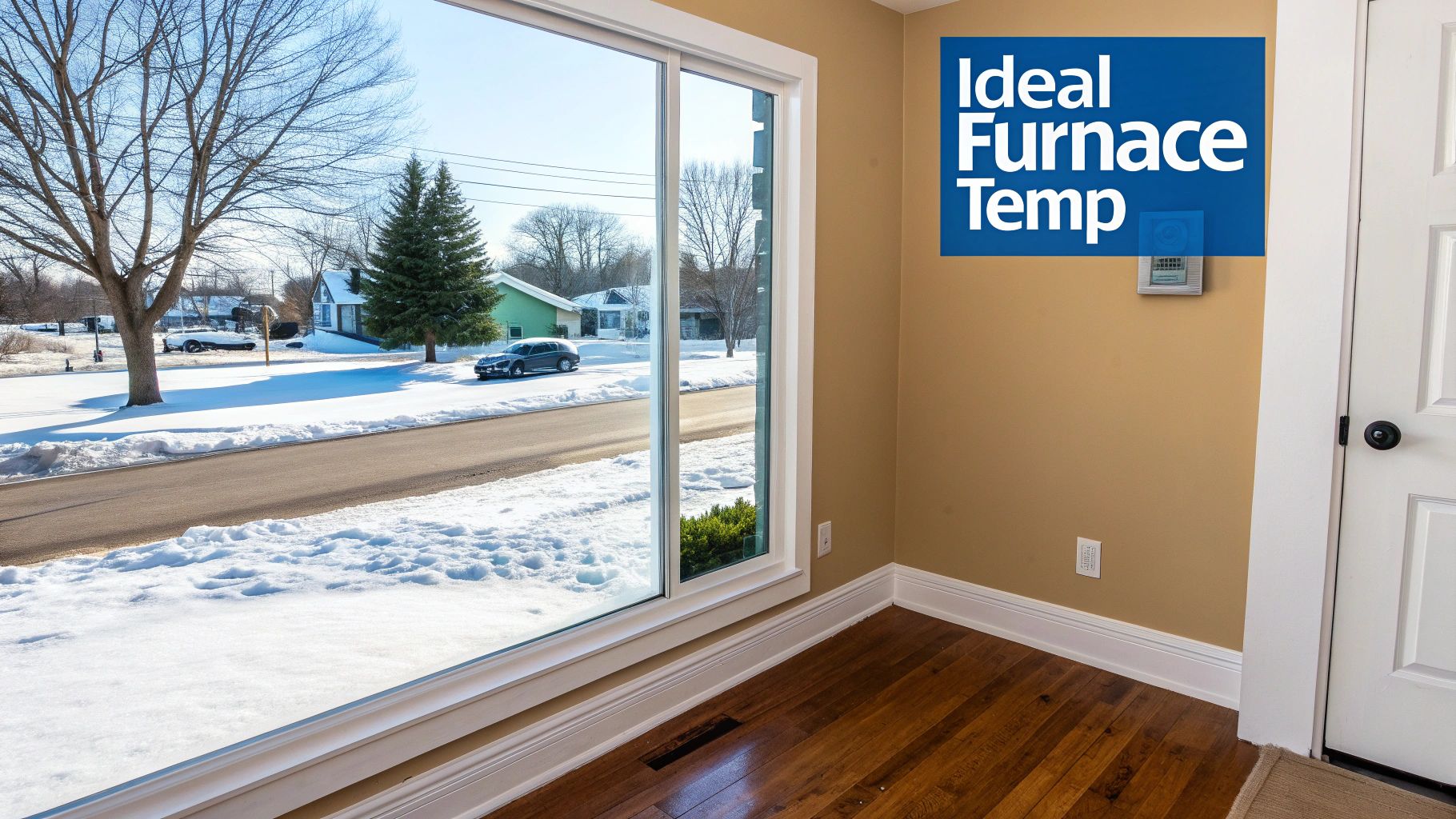
Dialing in the perfect temperature for your home is more than just comfort—it’s about creating a smart strategy that fits your daily life. There's a good reason the U.S. Department of Energy champions the "setback" method. It's a proven way to cut down your heating bills without feeling the chill.
Think about it: lowering the temperature when the house is empty or when everyone's bundled up in bed just makes sense. This simple approach stops you from paying to heat an empty space, which translates directly into lower energy use and a much friendlier utility bill. The goal is to find that sweet spot that keeps your family comfortable without overworking your furnace.
Embracing Cooler Temperatures for Bigger Savings
It might sound backward, but folks in the coldest climates often have the most frugal heating habits. Just look at the data: people in chilly Vermont, who face a staggering 7,746 heating degree days each year, keep their furnaces at a modest 63.4°F on average. Meanwhile, down in Texas, where winters are much milder, thermostats often sit at a toasty 69.9°F.
This trend shows how tough winters can inspire a thriftier mindset. You can explore more about these geographical thermostat habits and see how they impact energy use across the country.
It's all about a simple shift in perspective—seeing your thermostat as a tool for efficiency, not just a source of constant warmth. For a typical Minnesota household, making this change could easily mean hundreds of dollars in savings over a single heating season.
For a quick reference, here's a table with my go-to recommendations for Minnesota homes. It's a great starting point for building a schedule that maximizes both comfort and savings.
Recommended Minnesota Furnace Thermostat Settings
| Time of Day / Activity | Recommended Temperature (°F) | Potential Energy Savings |
|---|---|---|
| When You're Home & Awake | 68°F | Establishes a comfortable, energy-efficient baseline. |
| When You're Asleep | 60-62°F | Up to 10% savings by setting back for 8 hours. |
| When You're Away | 58-60°F | Maximizes savings by not heating an empty house. |
Remember, these are just guidelines. You can tweak them by a degree or two to find what feels best for your family while still keeping your energy bills in check.
Factors That Influence Your Perfect Temperature
Of course, no two homes are exactly the same. Your ideal furnace settings will depend on a few unique factors that you'll need to consider:
- Home Insulation: An older, draftier house in St. Cloud is going to lose heat a lot faster than a newer, well-insulated home in Blaine. That older home might need slightly different settings to feel just as comfortable.
- Personal Preference: Let's be honest, every family has a different tolerance for cold. The "perfect" temperature is ultimately whatever keeps your household comfortable and happy.
- Your Daily Schedule: If your house is empty for eight hours a day while everyone's at work or school, you can benefit from a more aggressive temperature setback. If someone is always home, your adjustments will be smaller.
Finding your sweet spot really just involves a bit of experimentation. Start with the recommended 68°F and adjust from there. Pay attention to how comfortable you feel and keep an eye on your energy bills to see the difference.
How to Program Your Thermostat for Automatic Savings
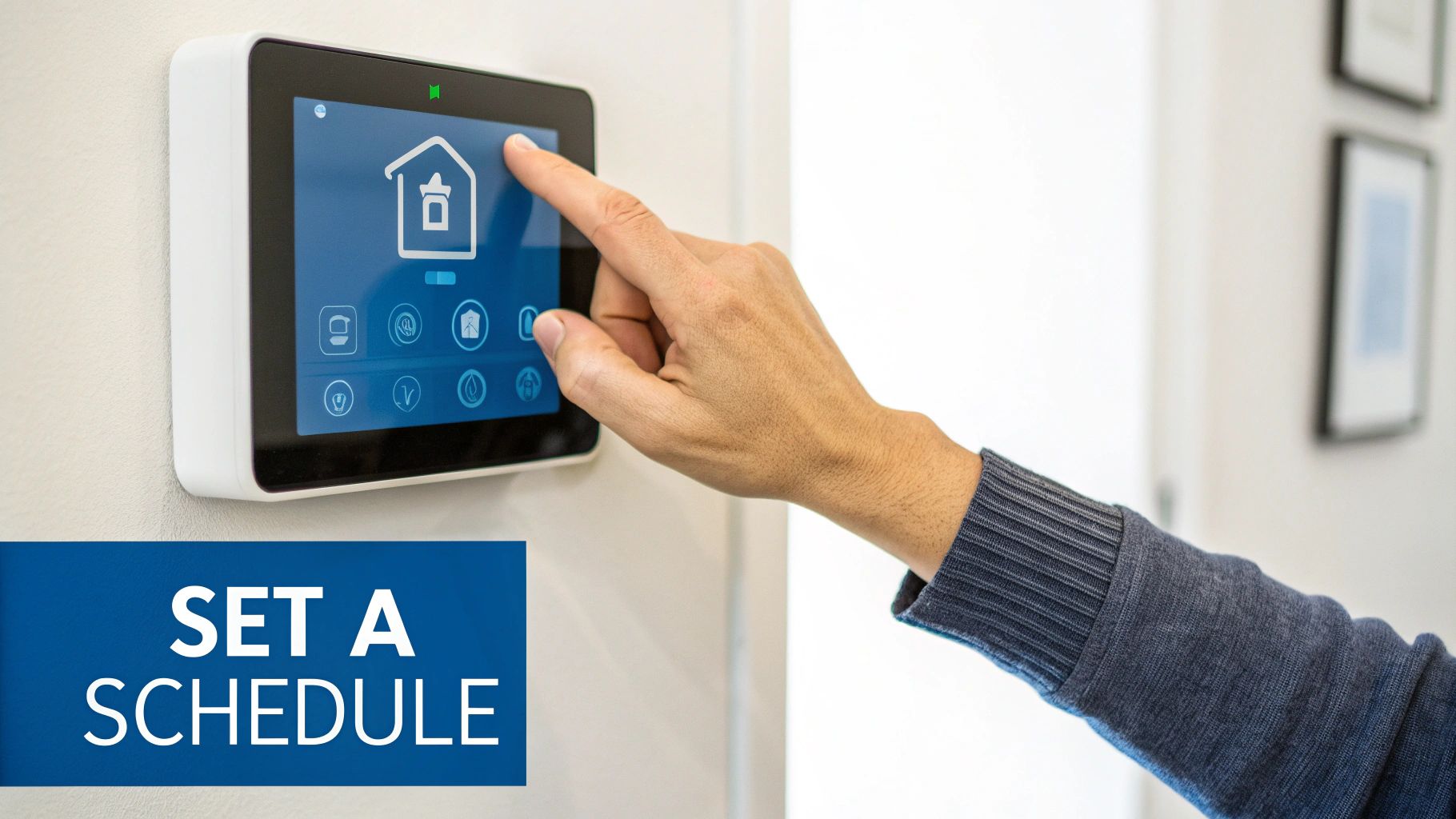
Manually tweaking the temperature is a decent start, but programming your thermostat is where the real, hands-off savings kick in. When you automate your furnace settings, you stop wasting money heating an empty house and turn smart temperature control into a seamless part of your daily routine. This is the key to unlocking consistent energy efficiency.
Whether you've got a classic digital programmable model or one of the newer smart thermostats, the idea is the same: create a schedule that matches your family's actual life. Taking this proactive approach gets you out of the habit of constantly fiddling with the dial, which can put unnecessary stress on your HVAC system and send your energy bills climbing.
Building Your Custom Heating Schedule
First things first, think about the rhythm of your week. Most households fall into a pretty predictable pattern, which makes setting up a basic program surprisingly simple. The goal is to create different temperature settings for the times you're home, away, or asleep.
A typical weekday schedule for a family in Minnesota might look something like this:
- Wake (6:00 AM): Program the thermostat to hit a comfortable 68°F right before your alarm goes off. No more waking up to a frigid house.
- Away (8:00 AM): Once everyone is out the door for work or school, let the temperature drop to around 58-60°F.
- Home (5:00 PM): Schedule the heat to kick back on, bringing the house back up to 68°F just as the family starts trickling in.
- Sleep (10:00 PM): Lower the temperature to a cozy 60-62°F for the night. You'll sleep better and save money while you do it.
Of course, your weekends will probably look a little different, with the "Home" temperature holding steady for longer stretches. Modern programmable thermostats and controls have made setting up these custom schedules easier than ever before.
Debunking the Furnace Recovery Myth
There's a common myth that holds a lot of people back from using temperature setbacks: the idea that a furnace has to work so much harder to reheat a cool house that it cancels out any savings. I'm here to tell you that’s just not true.
Heat loss is all about the temperature difference between the inside of your house and the outside. The cooler your home is, the slower it loses heat to the cold Minnesota air.
Think of it like a leaky bucket. A full bucket (a warm house) loses water much faster than one that's only half-full (a cooler house). Your furnace only needs to replace the heat that was lost, and less heat is lost when you let the temperature drop.
The research backs this up. Dropping the temperature by 7-10°F for eight hours a day can shave as much as 10% off your heating bill. National data shows that even in cold climates like ours, forced-air furnaces average around 70°F, proving that moderate settings are the sweet spot for efficiency.
Optimizing your thermostat is a fantastic start, but it's even more powerful when you pair it with other effective home energy conservation tips. Combining a smart schedule with other energy-wise habits is how you really start to see a difference in your monthly utility bills.
Why 68 Degrees Is the Magic Number for Your Furnace
You’ve probably heard it before: 68°F is the sweet spot for your thermostat in the winter. But why that specific number? It’s not just something people made up. It’s a carefully chosen benchmark that hits the perfect balance between keeping you comfortable, staying healthy, and not letting your energy bill get out of control.
Think of it as the starting line. It’s the temperature where most people feel cozy without forcing the furnace to work overtime.
For anyone living in Minnesota—especially those of us in older homes around Forest Lake or St. Cloud—adopting this benchmark is the first real step toward taming those monster winter heating costs. A home that isn't perfectly insulated loses heat fast, and your furnace ends up running constantly just to keep up. Sticking close to 68 degrees helps slow that heat loss down.
The Simple Science Behind the Savings
It all comes down to a really simple idea: the smaller the temperature difference between inside and outside, the slower your house loses heat. When you set your thermostat to 68°F instead of, say, 72°F, you’re literally reducing how quickly warmth escapes through your walls, windows, and roof.
That small change makes a huge difference in your energy bills and reduces the wear and tear on your furnace.
This isn't just a theory; it's backed by years of data. The U.S. Department of Energy has recommended 68 degrees for ages. Their research shows that for every single degree you lower your thermostat for an eight-hour stretch, you can save about 1% on your heating bill. You can learn more about these energy-saving furnace settings and see just how quickly those little adjustments add up.
Here’s the real kicker: by turning your thermostat back 7-10 degrees for eight hours a day—like when you’re at work or asleep—you could pocket up to 10% in annual heating savings. In a typical Minnesota home, that can easily mean $100 to $300 back in your pocket each year.
Finding What Feels Right for You
Of course, 68°F is just a guideline, not a hard-and-fast rule. Comfort is personal. What feels perfect to one person might feel a little chilly to someone else. The key is to use that temperature as your starting point and find your home’s unique sweet spot.
A few other things can affect what feels comfortable:
- Humidity Levels: Air with more moisture feels warmer. If the air in your home is really dry, 68°F might feel cooler than it actually is. A humidifier can make a huge difference.
- How Active You Are: A family with kids running around might feel great at a lower temperature than a household with more sedentary adults.
- Your Home's Layout: Open-concept homes and multi-story houses almost always have temperature inconsistencies. You might need to make small adjustments to compensate for a drafty living room or a warmer upstairs bedroom.
My advice? Start at 68°F. If it feels a bit cool, bump it up by one degree each day until everyone is comfortable without cranking it so high that your energy bill skyrockets. This personalized approach to your furnace thermostat settings is the best way to get both coziness and cost-efficiency.
Troubleshooting Common Thermostat Problems
Getting your furnace settings dialed in is a great start, but those perfect schedules won't mean a thing if the thermostat itself is on the fritz. It’s easy to jump to the worst conclusion when your furnace acts up, but more often than not, the real problem is a simple fix right at the control panel.
Before you start worrying about a big, expensive furnace repair, let's walk through some of the common thermostat glitches we see all the time here in Minnesota and how you can figure them out yourself.
A surprising number of issues boil down to one simple thing: power. If your thermostat display is totally blank or just won’t respond, the very first place to look is the batteries. I know it sounds almost too simple, but dead or weak batteries are the #1 reason a digital thermostat appears "dead." Most models have a little battery door that’s easy to pop open.
Why Are the Temperature Readings So Off?
Does it feel like you're living in an icebox even though the thermostat insists it’s a balmy 72 degrees? This is a frequent complaint, and the culprit is almost always something in the room, not the thermostat itself. A thermostat's location has a massive impact on its accuracy. Take a hard look at where yours is mounted.
- Direct Sunlight: Is it sitting in a spot that gets blasted with afternoon sun? That solar heat will trick the sensor into thinking the room is much warmer than it really is, causing your furnace to shut off way too early.
- Drafts: Is it near an exterior door, a drafty old window, or right next to a return air vent? A steady stream of cold air will convince it the room is always chilly, forcing your furnace to run constantly.
- Heat Sources: Don't forget about other heat sources. Placing it too close to a hot lamp, kitchen appliances, or even a TV can seriously throw off its readings.
The fix is often as straightforward as moving the thermostat to a more central, interior wall, away from all these outside influences.
A thermostat is only as smart as the information it gets. Making sure it’s in a spot that actually reflects your home's average temperature is the single most important step for accurate heating control.
The Furnace Won’t Turn On (Or Won't Turn Off)
Another maddening issue is a furnace that either runs nonstop or flat-out refuses to kick on. This can point to a few different things, and one of the most common is a simple buildup of dust. Over time, dust and debris can settle inside the thermostat's casing, getting in the way of its internal sensors and contacts.
You can try this yourself. Carefully take off the thermostat's cover and use a very soft brush or a can of compressed air to gently clean out the inside. This little bit of housekeeping can often clear up the connection problems that are preventing the thermostat from talking to your furnace.
If a good cleaning doesn't solve it, you might be dealing with something a little more complex. You can find more tips in our detailed guide on what to do when your thermostat is not reaching the set temperature.
Sometimes, the problem isn't a malfunction at all—it's just a setting that got bumped. Double-check that the system is actually set to "Heat" and not "Cool" or "Off." Pay attention to the fan setting, too. If it's on "On" instead of "Auto," the blower will run 24/7, even when the furnace isn’t heating. This constantly circulates air and can make it feel like cold air is blowing from your vents. Switching it back to "Auto" will fix that right away, ensuring the fan only runs when it's supposed to.
If you’ve run through these simple checks and you're still stuck, it's probably time to have a professional take a look.
Thinking Beyond the Thermostat for True Comfort
Dialing in your furnace thermostat settings is a huge step, but it’s a bit like having a star quarterback with a weak offensive line—it can't win the game on its own. True comfort and efficiency in your Minnesota home depend on your entire HVAC system working together. Your thermostat is the brain of the operation, but the furnace, air filters, and ductwork do all the heavy lifting.
When those other parts are neglected, even the most perfectly planned thermostat schedule won't be enough to overcome the underlying problems. A clogged air filter, for example, is like trying to breathe through a straw. It chokes off airflow, forcing your furnace to run harder and longer just to keep your home warm. That wastes energy and puts a ton of strain on the system, which can lead to an unexpected breakdown right in the middle of a cold snap.
The Hidden Impact of Your HVAC System
Think of your HVAC system as your home’s circulatory system. The furnace is the heart, pumping warm air through the ductwork—the arteries—to every single room. But if those arteries are leaky or blocked, some rooms will always feel chilly, no matter how high you set the thermostat.
This is one of the most common reasons people deal with frustrating hot and cold spots. In fact, leaky ductwork can lose a staggering 20% to 30% of the warm air moving through it. All that precious heat gets dumped into your attic, basement, or crawl spaces instead of your living room. You end up paying to heat parts of your house you don't even use. If that sounds familiar, our team at Neighborhood Plumbing, HVAC, and Electrical can help you avoid hot and cold spots in your home.
Creating a United Front for Home Comfort
To really get the most out of your furnace thermostat, you need to back it up with a healthy, well-maintained system. It’s a team effort, and this approach ensures every dollar you spend on heating delivers the comfort you expect.
Here’s what you can do:
- Regular Furnace Maintenance: Think of it like an oil change for your car. An annual tune-up keeps your furnace running at its best and lets us catch small issues before they turn into big, expensive emergencies.
- Clean Air Filters: Check your filter every month during the heating season. It’s one of the easiest and cheapest things you can do to boost performance.
- Sealed Ductwork: Making sure your ducts are properly sealed and insulated prevents massive energy loss and helps warm air get where it needs to go.
If you really want to get serious about finding where your home is losing heat, you might consider a blower door test. This is a professional diagnostic tool that can pinpoint hidden air leaks that are sabotaging your heating efforts.
The infographic below shows some of the most common thermostat issues we run into, which are often just symptoms of these deeper system problems.
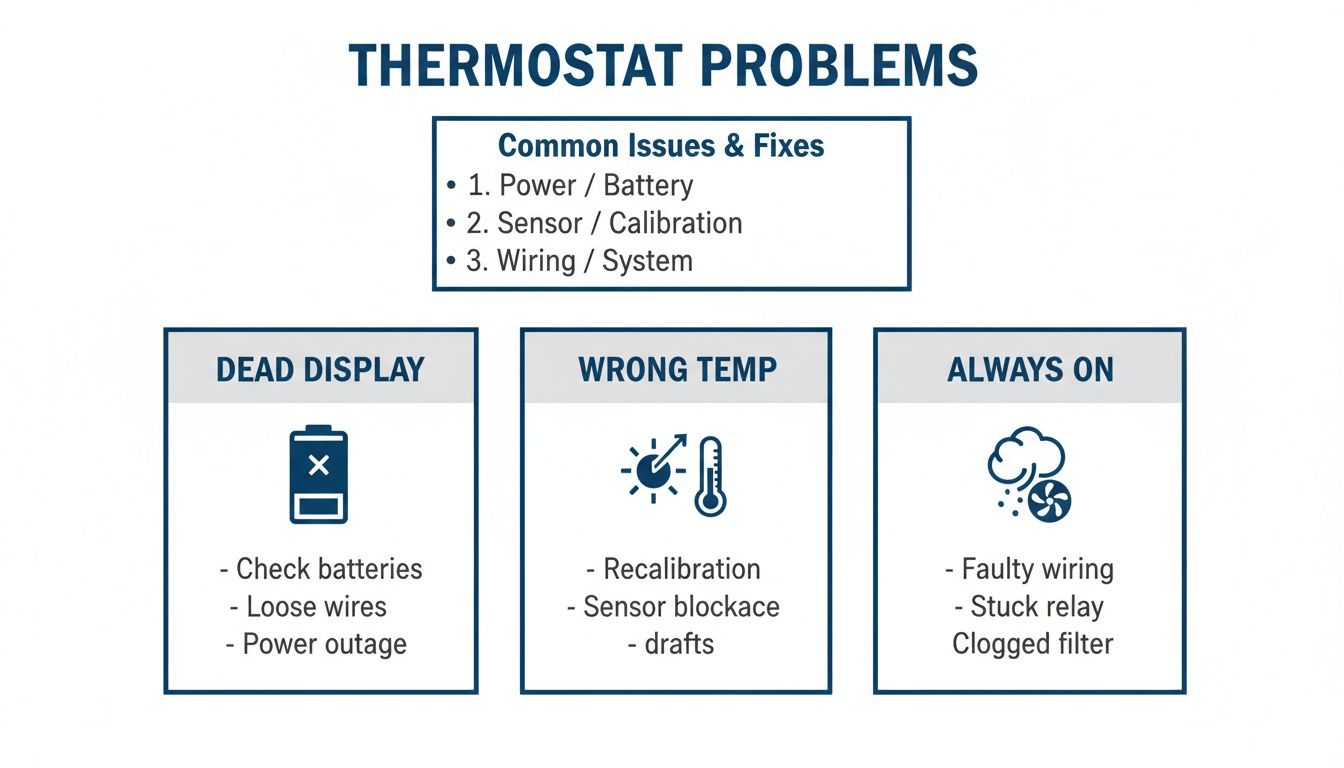
From a blank screen caused by dead batteries to wrong temperature readings because of bad placement, these little glitches show how even the command center itself can cause trouble.
At the end of the day, your thermostat is just one piece of a much larger puzzle. When you pay attention to the entire system—from the furnace itself to the ducts delivering the heat—you ensure that your carefully planned settings actually translate into real, consistent comfort and lower energy bills all winter long.
When You Need to Call a Professional
You can fix a lot of thermostat quirks on your own, but some problems are really just red flags for bigger issues hiding in your furnace or electrical system. Knowing how to spot the difference is key to protecting your HVAC system—and your family.
Ignoring these warning signs can turn a small, cheap fix into a massive, expensive repair. Some issues, especially with gas furnaces, just aren't safe to tackle yourself.
Red Flags That Demand an Expert Eye
If you notice any of these things happening, it’s time to put down the screwdriver and call a pro. These symptoms usually point to a problem with the furnace itself, the wiring, or major components that need a licensed technician's touch.
- Constant Short-Cycling: Is your furnace kicking on and off every few minutes? That’s not normal. This rapid cycling puts a ton of strain on the system and could be caused by anything from an oversized unit to a faulty flame sensor or a fried control board.
- Weird Noises: Furnaces should hum, not bang, rattle, or squeal. Those sounds are your furnace telling you something is wrong. It could be a loose part, but it could also be a blower motor on its last legs, which needs immediate attention.
- Sudden Spike in Your Energy Bills: If you haven't changed your habits but your heating costs just shot through the roof, it’s a dead giveaway your furnace is struggling. The cause could be a clogged system, failing parts, or even leaky ductwork.
CRITICAL SAFETY NOTE: If you ever smell rotten eggs, it could be a natural gas leak. Don't hesitate. Get everyone out of the house immediately, call your gas company from a safe distance, and then call an HVAC professional.
At the end of the day, your thermostat is just the brain of the operation. When the furnace itself starts showing signs of distress, calling in a professional from Neighborhood Plumbing, HVAC, and Electrical is the safest bet. We can accurately diagnose the root of the problem, whether it’s an electrical fault, a mechanical failure, or a serious safety concern.
Furnace Thermostat FAQs
We get a lot of questions from Minnesota homeowners about how their thermostats work. Here are some quick answers to the things people ask us most often.
Should I Set the Thermostat Fan to "ON" or "AUTO"?
For most people, most of the time, AUTO is the way to go. It's the most energy-efficient setting because the fan only kicks on when your furnace is actually heating your home. Simple as that.
Setting it to ON means the fan runs 24/7. While this can help circulate air and even out temperatures between rooms, it also uses a lot more electricity and can blow cool air through the vents when the furnace isn't firing up, which can feel a little chilly.
Does Fiddling With the Temperature All Day Waste Energy?
Yes, it absolutely does. Constantly cranking the heat up and then turning it down forces your furnace to work harder, cycling on and off more than it needs to. This not only burns through more fuel but also puts extra wear and tear on the system.
A programmable or smart thermostat is your best friend here. Just set a schedule and let it do the work—it’s the easiest way to break that costly habit.
Why Does My Thermostat Say It's a Different Temperature Than It Feels?
The number one culprit here is almost always poor placement. If your thermostat is catching a draft from a window, sitting in a sunny spot, or mounted too close to a heat source like a TV or a lamp, its sensor will get a skewed reading.
Your thermostat thinks the room is warmer or colder than it actually is, causing your furnace to run at the wrong times. It's a small detail, but its location makes a huge difference.